Pickleball balls: indoor or outdoor, which one to give?
Published on October 22, 2026 Edited October 22, 2026 Approx. 4 min
Signed: the Idées à Offrir editorial team.
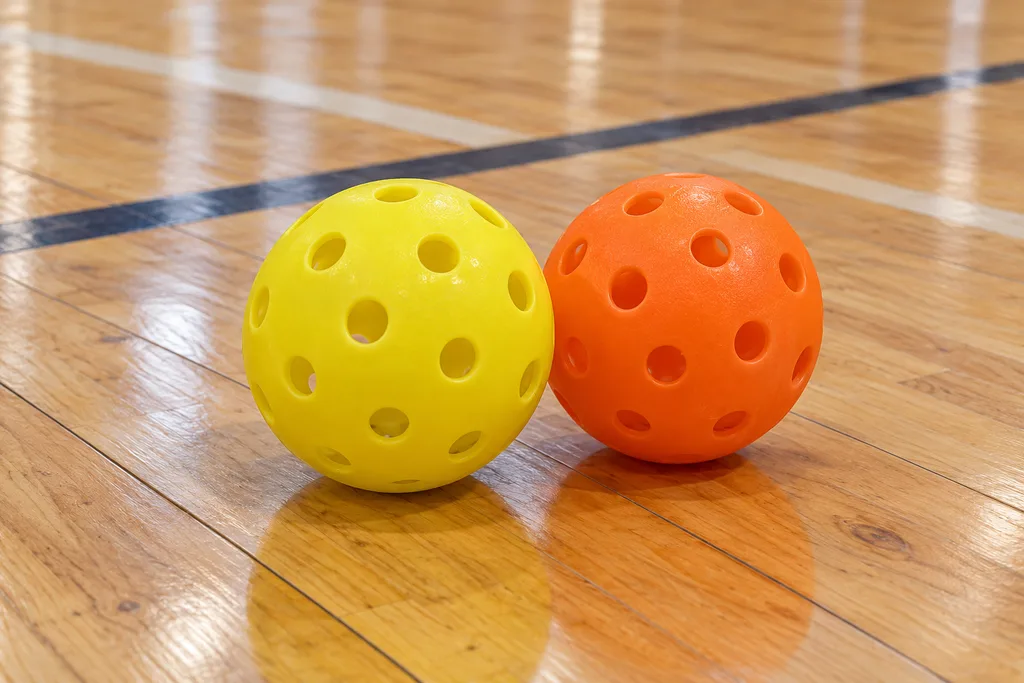
Take a seat for "Pickleball balls: indoor or outdoor, which one to give?", a route we've tried to keep clear, lively and free of pitfalls. You'll learn to tell indoor and outdoor balls apart so you give a set that fits where the person plays. Each stop has its purpose, and here's what you'll find: what's at stake in this choice, the compass for choosing and the big picture. Whether you're passing through or know the territory well, you may recognize yourself here: relatives, friends and colleagues of pickleball players, often new to the sport, who want a gift that suits the person's level and how they play.
What's at stake in this choice
The starting point is simple. The 2025 USA Pickleball rules set no limit on paddle thickness or weight. Only the dimensions (length, and length plus width) are regulated. Weight is up to the player. Keep that principle in mind as you read on.
Start with the basics. Pickleball was born in the United States in 1965 and reached France in 2015. It borrows from tennis, padel, badminton and table tennis, and it's played on a court the size of a badminton court. Keep that in mind as you read on.
Remember this guiding idea. Core thickness changes a paddle's stiffness a lot. Going from 13 to 16 mm, with the same materials, makes a paddle about 1.5 times stiffer in bending.
If you want a concrete landmark, take a look at the Rally pages, with "Raquette Rally — Carbone T700".
The compass for choosing
These points of comparison will help you pick your direction.
- A podiatrist considers shoes built for lateral movement, like tennis shoes, better suited to pickleball than running shoes, and points to models with a deeper heel for better control of sudden movements.
- Indoor balls have larger holes (between 26 and 30) and are lighter. Outdoor balls, with up to 40 holes, are harder and thicker so they hold up against wind and rough surfaces.
- A regulation pickleball has between 26 and 40 round holes, a smooth surface with no texture and a uniform color (apart from identification markings).
- Under USA Pickleball rules, shoe soles must not mark or damage the court's playing surface.
- A hardness of 40 to 50 on the Durometer D scale is recommended for a pickleball. According to the USA Pickleball page, it's no longer required for compliance.
The big picture
The scene comes into focus with the points below.
- According to the 2025 USA Pickleball rules, a paddle's length plus width can't exceed 24 inches (60.96 cm), and its maximum length is 17 inches (43.18 cm).
- For outdoor play, a radiation oncologist recommends broad-spectrum sunscreen of SPF 30 or higher, reapplied every 40 to 80 minutes, and avoiding long exposure between 10 h and 16 h.
- USA Pickleball publishes a list of approved paddles with more than 2,500 models. The manufacturer, the model and the approval must be clearly marked on the paddle.
- According to the 2025 USA Pickleball rules, a paddle face must be made of a rigid, non-compressible material. It can't show delamination, holes, cracks, a rough texture or dents. A paddle damaged in this way is no longer compliant.
Last stop
Keep exploring at your own pace by browsing the other pages of the site.
On the same topic
- Paddle approval and delisting: what the JOOLA Gen 3 case teaches buyers — You'll see why a paddle can lose its approval, and how to check the official list before you give one as a gift to a player.
- Gifting a pickleball paddle: what to check before buying — You'll know which questions to ask and which criteria to check to give a paddle that suits the person. A step-by-step road map.
- Cap, visor and sunscreen: dressing an outdoor player by season — You'll put together a clothing and sun-care gift that suits the season. Reading route: the benchmarks for choosing, plus a grid of criteria to apply.
Sources cited
- 2025 USA Pickleball Rules, Section 2 : Court and Equipment — Restates the USA Pickleball rules on the court, the net, the paddle and the ball; to be cross-checked with the FFT. Source read on 2026-10-18.
- La Fédération française de tennis obtient la délégation du pickleball, sport en vogue — Announcement of the delegation (January 3, 2026), participation figures, the history of pickleball and its arrival in France in 2015. Source read on 2026-10-18.
- Pickleball Paddle Materials — Technical page on paddle materials (cores and faces). No sales offer. Source read on 2026-10-19.
- A podiatrist's pickleball pointers (Parkview Health) — A podiatrist's advice on shoes. Source read on 2026-10-21.
- Indoor vs outdoor pickleball balls (USA Pickleball) —
- Pickleball clothing: USA Pickleball rules — Rules page on clothing and shoes, with no sales offer. Source read on 2026-10-21.
- Q&A: un radio-oncologue explique comment protéger sa peau en jouant au pickleball (Texas Oncology) —
- USA Pickleball approved paddles — Overview of USA Pickleball's list of approved paddles (more than 2,500 models) and how to search it. Source read on 2026-10-18.
Advice on protection (eyes, joints, shoes) is general in nature and doesn't replace the advice of a doctor or health professional.
The equipment approval rules cited here come mainly from USA Pickleball. In France, the FFT has set the official framework since 2026: check the requirements before you give equipment meant for competition.
Our fact-checking.
- This article cites 8 sources: 1 reference body and 1 specialized or general press article.
- Facts checked against their sources on October 19, 2026.
- The method we follow: Nos engagements.