Paddle approval and delisting: what the JOOLA Gen 3 case teaches buyers
Published on October 22, 2026 Edited October 22, 2026 Approx. 4 min
Signed: the Idées à Offrir editorial team.
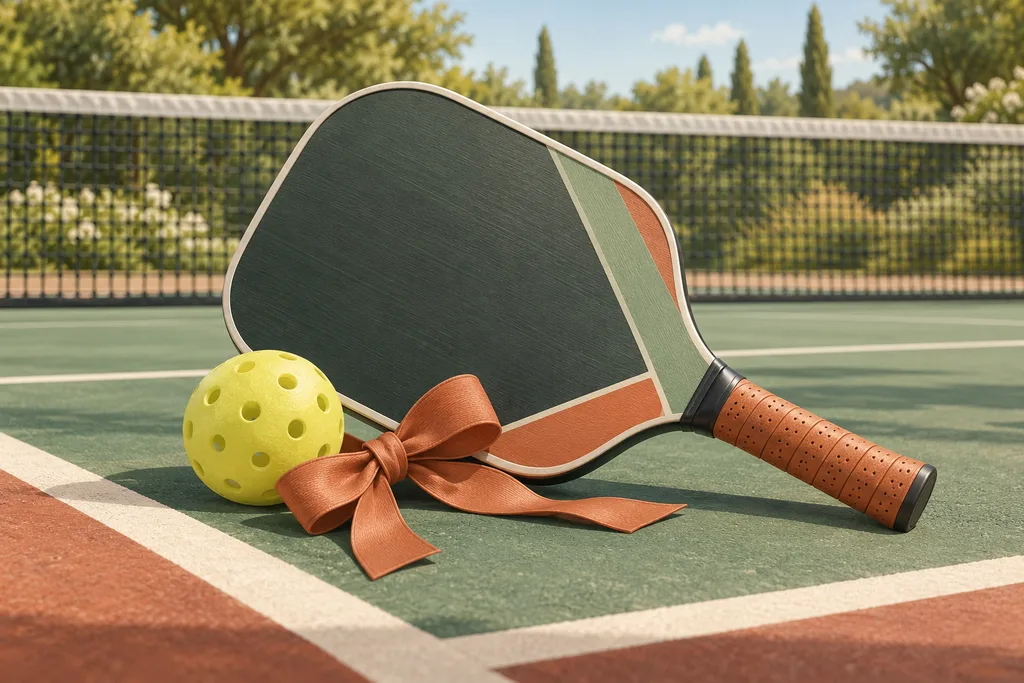
With “Paddle approval and delisting: what the JOOLA Gen 3 case teaches buyers,” we open a trail you can follow without a map or compass. You'll see why a paddle can lose its approval and how to check the official list before you give one as a gift. The route breaks down like this: what the court reveals, the engine of the affair, and the compass for choosing. The trail is marked out for you if this describes you: relatives, friends and colleagues of pickleball players, often new to the sport, who want a gift that suits the person's level and the way they play.
What the court reveals
Start with the principle: at a USA Pickleball tournament, a player must not wear clothing whose color is close to that of the ball (bright yellow-green). Avoid it for a gift meant for a competitor.
Hold on to this guiding idea: pickleball was born in the United States in 1965 and reached France in 2015. It borrows elements from tennis, padel, badminton and table tennis, and it's played on a court the size of a badminton court.
Hold on to this guiding idea: core thickness clearly changes a paddle's stiffness. Going from 13 to 16 mm, with the same materials, makes the paddle about 1.5 times stiffer in bending. Keep this principle in mind as you read on.
Hold on to this guiding idea: the 2025 USA Pickleball rulebook sets no limit on paddle thickness or weight. Only the dimensions (length, and length plus width) are regulated. Weight is therefore the player's call. Let this benchmark be your thread through the lines that follow.
The engine of the affair
At the root of it all: graphics, logos, images and lettering on clothing must stay in good taste, and a player can be asked to change clothing judged inappropriate for safety or distraction reasons. Remember this milestone, it comes back later.
Here's the starting point: for paddle faces, carbon fiber and graphite are described as very stiff, comparable to aluminum. Kevlar has a stiffness close to that of fiberglass, but it absorbs more bending deformation before it breaks.
The compass for choosing
Run each criterion below through your own filter before you decide.
- USA Pickleball publishes a list of approved paddles with more than 2,500 models; the manufacturer, the model and the approval must be clearly marked on the paddle.
- Indoor balls have larger holes (between 26 and 30) and are lighter; outdoor balls, with up to 40 holes, are harder and thicker to stand up to wind and rough surfaces.
- Under the 2025 USA Pickleball rulebook, a paddle face must be made of a rigid, non-compressible material. It must show no delamination, holes, cracks, rough texture or dents. A paddle damaged in this way is no longer compliant.
- There are three main families of paddle cores. Aluminum honeycomb is the stiffest and offers the best strength-to-weight ratio. Polypropylene is the least stiff but the best at damping shocks and vibrations. Nomex is paper coated in phenolic resin, lighter than aluminum but more expensive.
- The USA Pickleball standard specifies a ball's bounce: 30 to 34 inches, measured at the top of the ball when it's dropped from a height of 78 inches.
The ruts to avoid
Watch out for this rut: the 2025 USA Pickleball rulebook bans non-slip or textured paint, rubber or synthetic rubber, sandpaper-like features and moving parts that add swing weight on a paddle. A paddle tinkered with using these is one to rule out as a gift.
In your travel bag
Here's the postcard from this trip, in a few strokes.
- Core thickness clearly changes a paddle's stiffness.
- The USA Pickleball standard specifies a ball's bounce.
At the end of the route
Come back to these lines whenever doubt creeps in: the trail stays marked.
On the same topic
- Five common mistakes when gifting pickleball gear to a beginner — You'll sidestep the classic traps: a model that's too advanced, non-compliant gear, the wrong type of ball. A step-by-step roadmap.
- Pickleball balls: indoor or outdoor, which one to give? — You'll learn to tell indoor and outdoor balls apart, so you can give a set that fits where your player plays. Detailed points of comparison.
- Gifting a pickleball paddle: what to check before buying — You'll know which questions to ask and which criteria to check to give a paddle that suits the person. A step-by-step road map.
Sources cited
- Pickleball clothing: USA Pickleball rules — Rules page on clothing and shoes, no sales offer. Document accessed on 2026-10-21.
- La Fédération française de tennis obtient la délégation du pickleball, sport en vogue — Announcement of the delegation (January 3, 2026), participation figures, history of pickleball and its arrival in France in 2015. Document accessed on 2026-10-18.
- Pickleball Paddle Materials — Technical page on paddle materials (cores and faces). No sales offer. Document accessed on 2026-10-19.
- 2025 USA Pickleball Rules, Section 2 : Court and Equipment — Rundown of the USA Pickleball rules on the court, net, paddle and ball; cross-check with the FFT. Document accessed on 2026-10-18.
- USA Pickleball approved paddles — Overview of the USA Pickleball approved paddle list (more than 2,500 models) and how to search it. Document accessed on 2026-10-18.
- Indoor vs outdoor pickleball balls (USA Pickleball) —
The advice on protection (eyes, joints, shoes) is general and doesn't replace the advice of a doctor or health professional.
The equipment approval rules cited come mainly from USA Pickleball. In France, the FFT has set the official framework since 2026: check the requirements before giving gear meant for competition.
Our fact-check.
- This article cites 6 sources: 1 trade or general press article.
- Facts checked against their sources on October 19, 2026.
- The method we follow: Nos engagements.