Which pickleball paddle should you give? A guide to getting it right
Published on October 22, 2026 Edited October 22, 2026 Approx. 6 min
Signed by the Idées à Offrir editorial team.
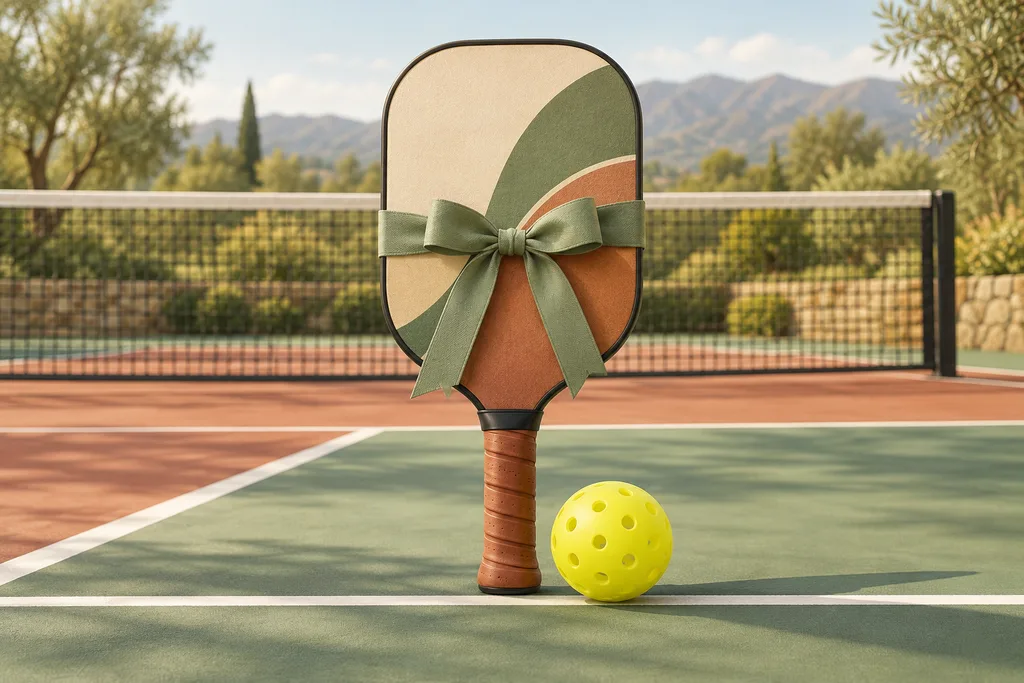
The paddle is the most personal gift. Every player has habits when it comes to weight and feel. This section shows you how to find your way, and when approval matters. The "Paddles and balls" section welcomes you with its landmarks, its terms and its articles.
The ideas that guide the route
First, core thickness changes a paddle's stiffness a lot. Going from 13 to 16 mm, with the same materials, makes the paddle about 1.5 times stiffer in bending. Keep this in mind as your guide through the lines that follow.
Here's the thread to follow: at a USA Pickleball tournament, a player can't wear clothing close to the color of the ball (bright yellow-green). Avoid it for a gift meant for a competitor. Keep this in mind as your guide through the lines that follow.
Start here: graphics, logos, images and lettering on clothing must stay in good taste. A player can be asked to change a garment judged inappropriate for safety or distraction reasons.
Keep this compass in hand: pickleball was born in the United States in 1965 and reached France in 2015. It borrows elements from tennis, padel, badminton and table tennis, and it's played on a court the size of a badminton court. Reread this sentence if you need to. The rest of the trail builds on it.
Here's the thread to follow: the 2025 USA Pickleball rulebook sets no limit on paddle thickness or weight. Only the dimensions (length, and length plus width) are regulated. Weight is the player's choice.
The routes through this section
Here are the stops to explore, in whatever order suits you.
- Offrir une raquette de pickleball : les critères à vérifier avant d'acheter — you'll know which questions to ask and which criteria to check to give a paddle that suits the person.
- Homologation et déhomologation des raquettes : ce que le cas JOOLA Gen 3 enseigne aux acheteurs — you'll understand why a paddle can lose its approval, and how to check the official list before you give one.
- Balles de pickleball : intérieur ou extérieur, laquelle offrir ? — you'll learn to tell indoor balls from outdoor balls, so you can give a set that fits where the person plays.
- Cinq erreurs fréquentes quand on offre du matériel de pickleball à un novice — you'll avoid the classic traps: a model that's too advanced, non-compliant gear, the wrong ball type.
- Offrir une tenue de pickleball : tailles, saisons et salle ou extérieur — you'll learn to choose an outfit for the place and season, without getting the size wrong.
Getting started
Here are the steps to follow, from the first marker to the last.
- Long-sleeved clothing or pants, plus sunglasses, round out the protection of skin and eyes during outdoor sessions.
- For outdoor play, a radiation oncologist recommends broad-spectrum sunscreen of SPF 30 or higher, reapplied every 40 to 80 minutes, and avoiding prolonged exposure between 10h and 16h.
- The rules allow certain modifications to a paddle — edge guard tape, weighted tape, a grip change and original replacement parts. Decals are limited to 2.54 cm (1 inch) above the handle. So you can give a customization accessory without making the paddle illegal.
- A paddle that's already approved can take permitted modifications (replacing the edge guard, changing the grip, weighted tape, a vibration dampener), as long as it stays within USA Pickleball specifications.
Markers for the decision
These landmarks help you choose your path with your eyes open.
- According to USA Pickleball, a pickleball measures 2.87 to 2.97 inches in diameter and weighs between 0.78 and 0.935 ounces. The ranges are narrow, so two compliant balls are almost the same size.
- According to the 2025 USA Pickleball rulebook, the length and width of a paddle combined can't exceed 24 inches (60.96 cm), and its maximum length is 17 inches (43.18 cm).
- Indoor balls have larger holes (between 26 and 30) and are lighter. Outdoor balls, with up to 40 holes, are harder and thicker to stand up to wind and rough surfaces.
- A regulation pickleball has between 26 and 40 round holes, a smooth surface with no texture, and a uniform color (apart from identification markings).
A few more landmarks
Here's a case that speaks for itself: the first pickleball paddles, in 1965, replaced table tennis paddles with larger, more durable plywood ones. The game first used a Wiffle ball, then the Cosom Fun Ball, judged more durable.
Where people often go wrong
Here are the missteps to steer around before you go further.
- The 2025 USA Pickleball rulebook bans non-slip or textured paint, rubber or synthetic rubber, sandpaper-like features and moving parts that add swing momentum on a paddle. A paddle tinkered with in these ways should be crossed off your gift list.
- At a tournament, the tournament director picks the balls from the official list of approved balls, published on the USA Pickleball and GPF sites. So a random recreational ball isn't necessarily usable in competition.
- If a player refuses to follow the clothing rules at a tournament, the tournament director can declare a forfeit of the match.
Additional stops
One thing tips the scales: USA Pickleball publishes a list of approved paddles with more than 2,500 models. The manufacturer, the model and the approval must be clearly shown on the paddle.
On the same topic
- Paddle approval and delisting: what the JOOLA Gen 3 case teaches buyers — You'll understand why a paddle can lose its approval and how to check the official list before you give a paddle as a gift.
- Gifting a pickleball paddle: what to check before buying — You'll know which questions to ask and which criteria to check to give a paddle that suits the person. A step-by-step road map.
- Five common mistakes when giving pickleball gear to a beginner — You'll sidestep the classic traps: a model that's too advanced, non-compliant gear, the wrong ball type. A step-by-step roadmap.
- Pickleball balls: indoor or outdoor, which should you give? — You'll learn to tell indoor and outdoor balls apart, so you can give a set that suits where the person plays. The comparison points, in detail.
Sources cited
- Pickleball Paddle Materials — Technical page on paddle materials (cores and faces). No sales offer. Document consulted on 2026-10-19.
- Pickleball clothing: USA Pickleball rules — Rules page on clothing and shoes, with no sales offer. Document consulted on 2026-10-21.
- La Fédération française de tennis obtient la délégation du pickleball, sport en vogue — Announcement of the delegation (January 3, 2026), participation figures, the history of pickleball and its arrival in France in 2015. Document consulted on 2026-10-18.
- 2025 USA Pickleball Rules, Section 2 : Court and Equipment — Restatement of the USA Pickleball rules on the court, the net, the paddle and the ball; to be cross-checked with the FFT. Document consulted on 2026-10-18.
- Q&A: un radio-oncologue explique comment protéger sa peau en jouant au pickleball (Texas Oncology) —
- USA Pickleball approved paddles — Overview of the USA Pickleball list of approved paddles (more than 2,500 models) and how to look it up. Document consulted on 2026-10-18.
- Indoor vs outdoor pickleball balls (USA Pickleball) —
- Pickleball (Wikipédia, version anglaise) — Online encyclopedia. Used here for the history of the equipment (first paddles and balls). Document consulted on 2026-10-19.
The advice on protection (eyes, joints, shoes) is general and doesn't replace the advice of a doctor or health professional.
The equipment approval rules cited come mainly from USA Pickleball. In France, the FFT has set the official framework since 2026: check the requirements before you give equipment meant for competition.
Our verification.
- This article cites 8 sources: 1 specialized or general press article.
- Facts checked against their sources on October 19, 2026.
- The method we follow: Nos engagements.